The majority of Americans are unsatisfied with the two-party system. It is easy to see why. The limited offerings of the two-party system mean that only the Democratic Party and Republican Party must simultaneously represent the interests of millions of diverse people. This has several consequences for American policy.
First, it makes it difficult for alternative viewpoints to be heard. Smaller parties, such as Green parties, in other countries have been included in the government as part of governing coalitions. In the United States, since the Civil War, there have only been 152 members of Congress elected from third parties. This means that less than 2% of all politicians since the mid-1800s have not been affiliated with some variant of the Democratic Party or Republican Party.
Second, it leads to policy stability. This can actually be a positive of the two-party system as stability can lead to economic growth and long-term planning. However, in times where there is an increased call to reform programs and processes, it serves as a negative feature of the system as it can also lead to gridlock. As the Democratic Party and Republican Party have moved away from each other in terms of their policy platforms, this has sadly been the current situation with compromise increasingly difficult to achieve.
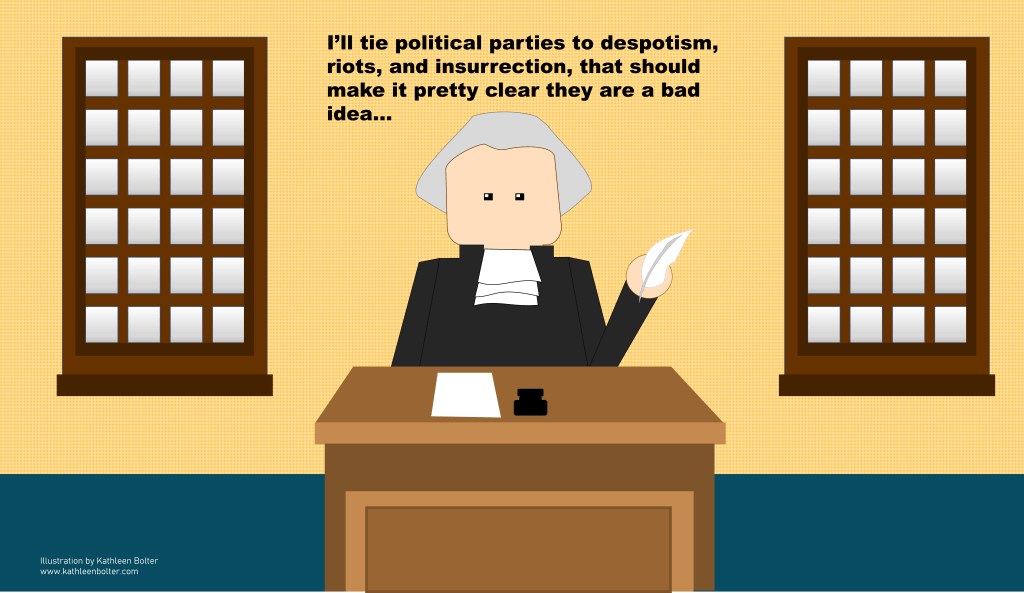
Dissatisfaction with the two-party system has been around since the founding of the United States. George Washington famously warned against the two-party system in his farewell address citing the ability of political parties to create conflict and lead to hostility between people. He predicted this animosity would lead to a “spirit of revenge” causing Americans to vote based on party loyalty, rather than for what was in the common interest of the nation. Washington was the only President to be elected that was not from a political party. His presidency was followed by John Adams, who affiliated with the Federalists and then Thomas Jefferson, who affiliated with the Democratic-Republicans. Despite Washington’s warning, two main political parties in the United States had already formed.
To recap, people today are generally dissatisfied with the two-party system and it has been viewed as a problem from the beginning. So why does the United States only have two political parties? To understand this, we have to look at our electoral system and how we allocate votes to winning parties.
Around the world, there are dozens of different types of voting systems that are mixed and matched to determine the winner of elections. For simplicity sake, we are going to focus on three main types: Proportional representation voting systems, majoritarian voting systems, and plurality voting systems.
Let’s say we have three political parties running for election. Based on the electoral voting system in their country, there would be three potential outcomes for the election.
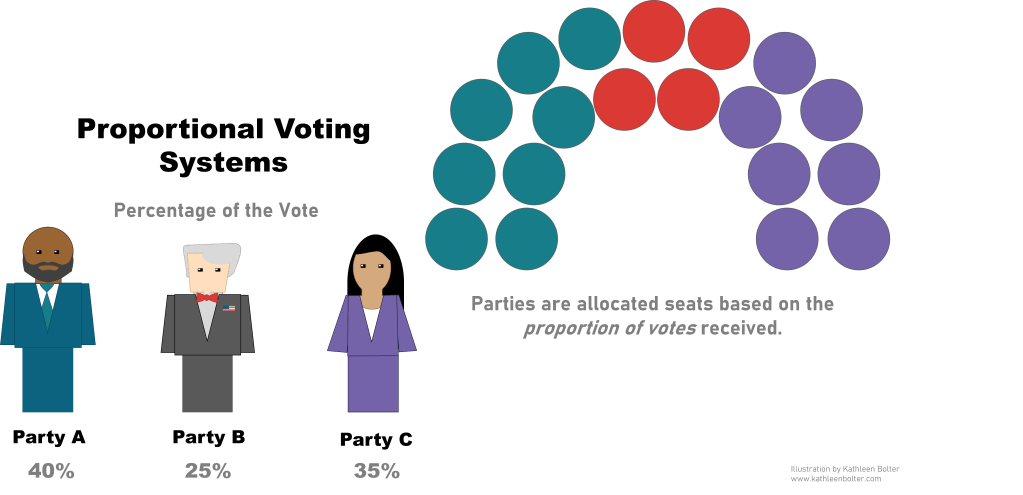
In a country with a proportional representation voting system, the electoral body represents the relative number of votes each party received. Proportional representation systems tend to be more inclusive and represent diverse interests. They allow for greater variety of candidates and political parties to be elected. Proportional representation systems also have some downsides as they can potentially provide a route for extreme parties to force their way into the mainstream.
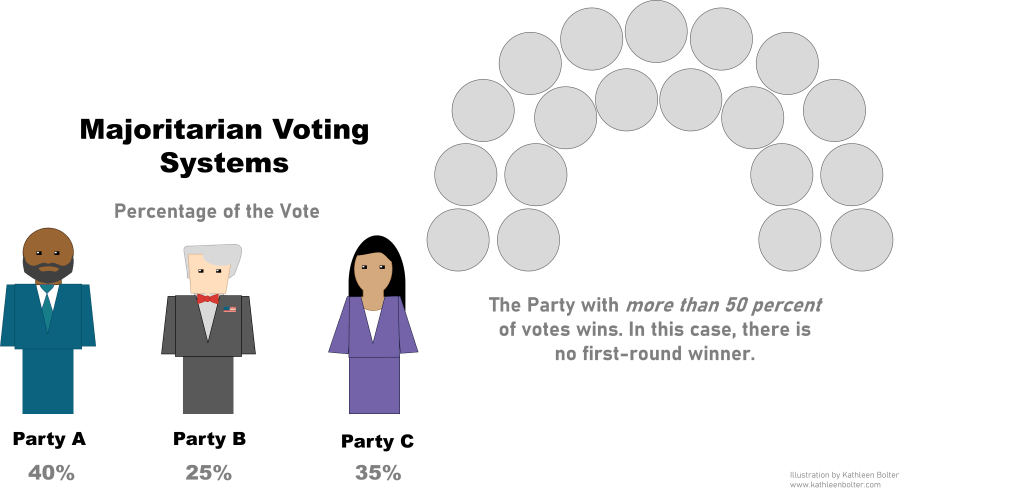
In a country with a majoritarian voting system, the electoral body is decided by whichever party gets an absolute majority, essentially, more than 50% of votes. In countries in which there are more than two political parties running, this can mean there is no winner in the first-round election. Different countries have different rules for how these elections are determined, with some having a “runoff” election between the two candidates receiving the highest number of votes and others having voters rank the candidates to determine who is the most popular. Majoritarian voting systems tend to produce more parties than plurality systems, but fewer than proportional representation systems.
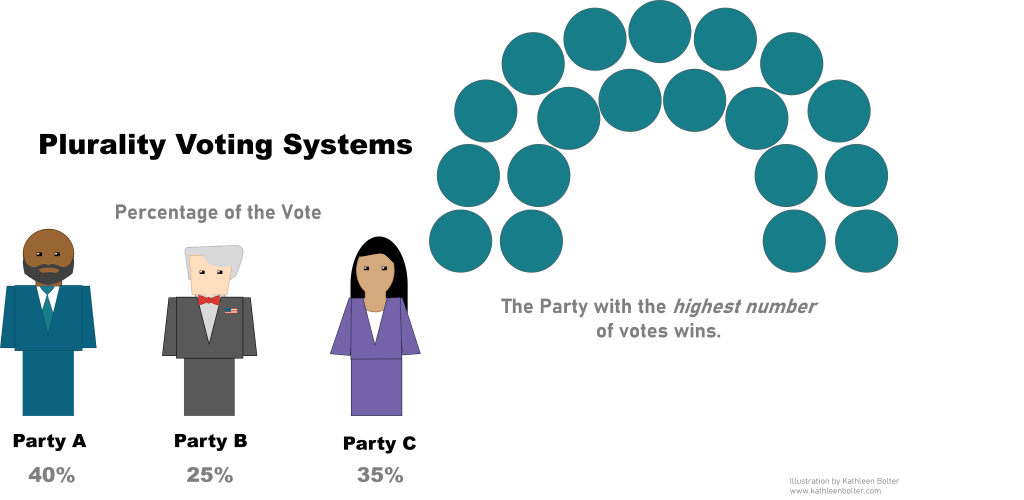
In a country with a plurality voting system, the electoral body is decided by whichever party the most votes. The party does not need a majority to win. Plurality systems are easy to understand as you simply vote for your preferred candidate. They also tend to produce a disproportionate number of seats for the majority party, which, leads to a fewer number of stronger parties.
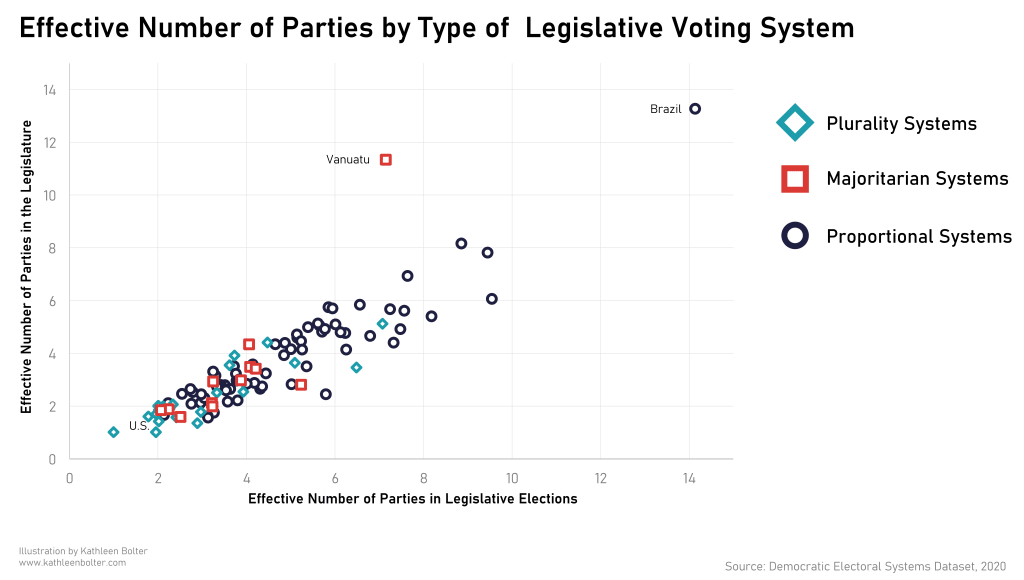
Overall, there are large differences between the number of political parties in an election and the number of political parties serving in the legislature and the major type of electoral system. Proportional representation systems have on average 5 political parties to choose from in each legislative election, with an average of 4 parties serving in each government. Majoritarian systems have on average 4 political parties to choose from in each legislative election, with an average of 3 parties serving in each government. Plurality systems have on average 3 political parties to choose from in each legislative election, with an average of 2 parties serving in each government. There is a very strong connection between how we choose our elected representatives and how many political parties are represented in government.
Part of the reason the United States has only two political parties is because of how our voting system is structured. The United States has a plurality voting system which means the party with the most number of votes wins the election. Unlike many other governmental structures, the plurality voting system in the United States is something that could be reformed. Article I of the U.S. Constitution grants States the authority to determine the rules by which they elect U.S. Senators and Representatives (although this assumes Congress does not pass any laws to change those rules). Some states have chosen to reform their electoral systems for members of Congress including Louisiana, Georgia, and Maine which instituted majoritarian voting systems for those offices.
The electoral system adopted by a country plays an outsized role on how the political structure of that country functions. However, the winner-take-all system in the United States is only partially responsible for why the country has two dominant political parties. Other factors such as tradition and single-member districts also play a role. That being said, if dissatisfied with the current state of the two-party system, reforming how we elect our representatives is the first place we should look if the goal is to include a greater number of parties, more in line with the needs of the people into the political process.
 Kathleen Bolter, PhD