
Originally published here.
Key Takeaways
- Occupational change as a result of technology adoption is slow, but inevitable.
- Automating routine tasks can be both beneficial for businesses, through cost reduction, and workers, by reducing mundane tasks.
- Technology adoption means the jobs of the future will require different skills and training.
Following WWII there was an increased demand for banking services from the general public. As a result, banks needed to increase their staff, including Bank Tellers.
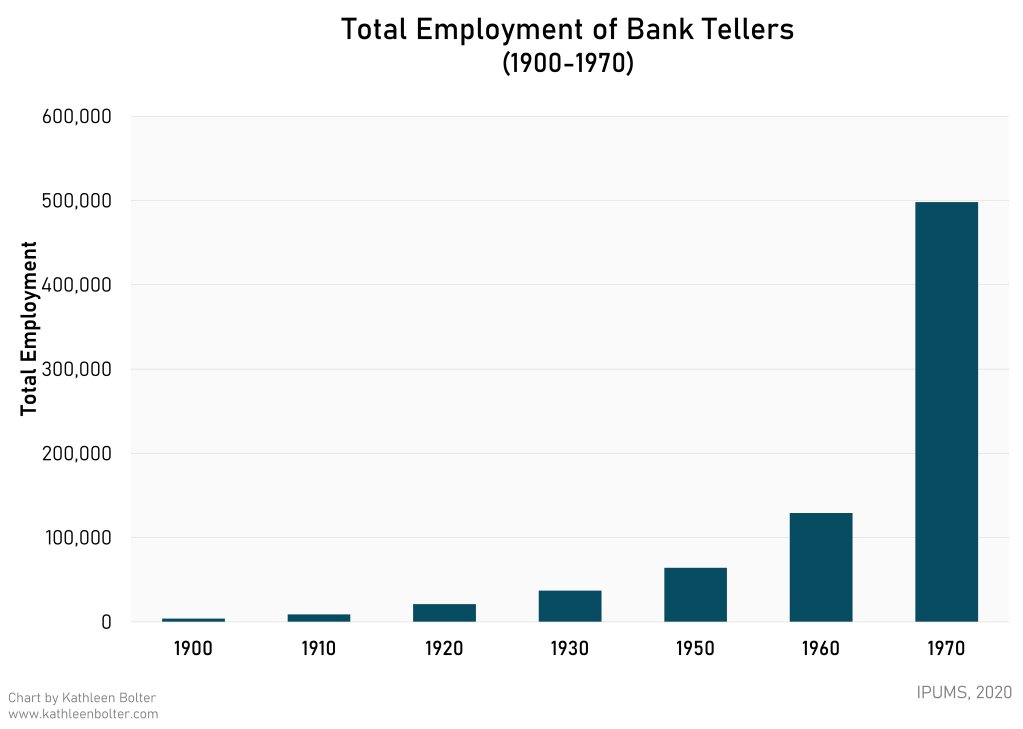
As the number of bank customers multiplied, the teller began performing routine transactions for a large number of customers. This included cashing checks, depositing money, and answering questions from customers about their accounts.

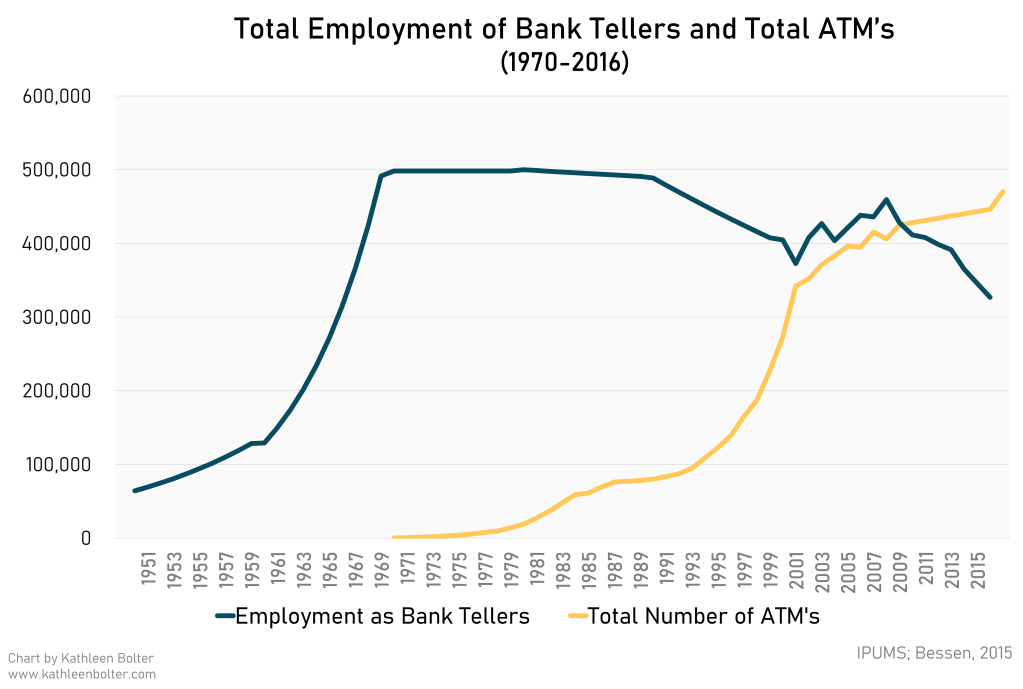
The first ATM’s were introduced into commercial banks in the 1960’s and become ubiquitous in most banks by the 1990’s. Like tellers, they could accept checks and cash for deposit, display account information and issue cash.

The introduction of ATM’s reduced the need to hire bank tellers to perform the same functions. As a result, technology served as a substitute for the tasks of the bank teller, leading to a decrease in employment.
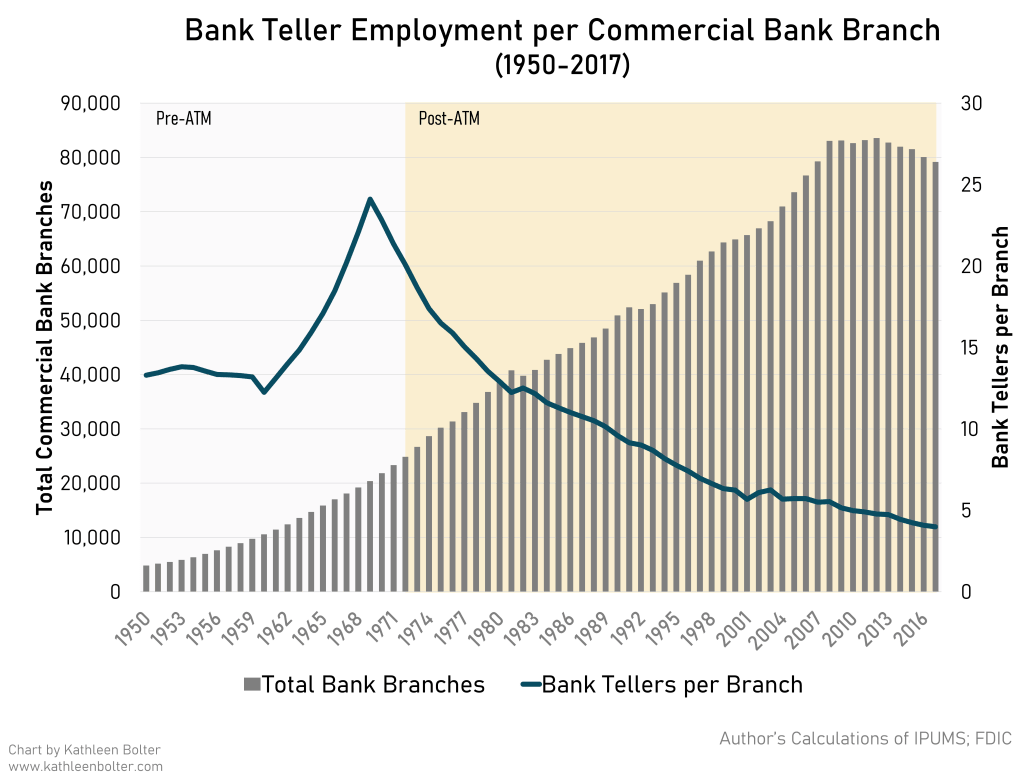
At the same time, the automation provided by the ATM allowed banks to operate more efficiently. As a result, they opened more branches. However, they staffed them with fewer tellers.
Today about 60% of Teller duties can be done by an ATM. As ATM technology becomes more sophisticated, up to 90% of teller duties are expected to be automated by ATMs.

As ATM’s have relieved Bank Tellers from many of their routine tasks, the job duties of Bank Tellers have changed.

As ATM’s have relieved Bank Tellers from many of their routine tasks, the job duties of Bank Tellers have changed.
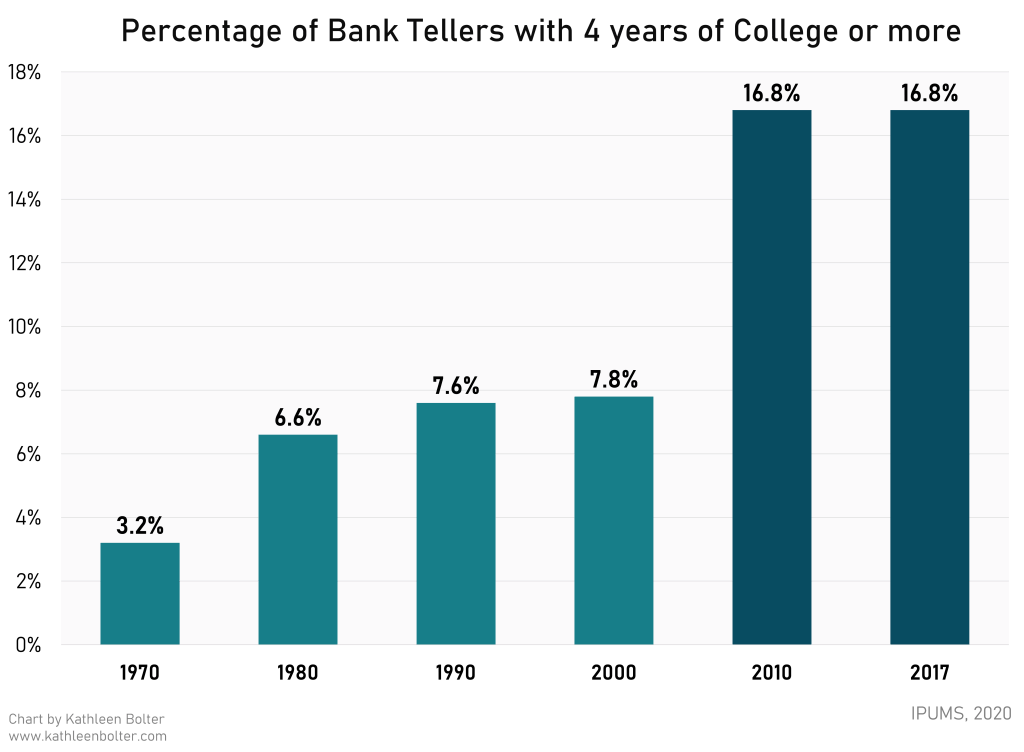
As a result of Automation, this means more education is needed for this job. This is also known as skills biased technological change. As technology replaces routine tasks, the tasks left for people to complete are more complex and require more training to do.
Conclusion
- Routine jobs are not predicted to grow. Many of their tasks are likely to be automated resulting in little or no job growth.
- In the transition to automation, jobs will see their tasks and duties change. This will require workers to be flexible and able to adapt to new technologies.
- As the tasks of jobs change, workers will need new skills in order to perform these functions.
Sources
Autor, David H., Frank Levy, and Richard J. Murnane. “The skill content of recent technological change: An empirical exploration.” The Quarterly journal of economics 118, no. 4 (2003): 1279-1333.
Bessen, James. Learning by doing: the real connection between innovation, wages, and wealth. Yale University Press, 2015.
 Kathleen Bolter, PhD
Leave a comment