
When it comes to political parties, the United States has a decidedly unique system. We are one of only a handful of countries with only two dominant political parties (you can thank Duverger’s law for this one). And, for most of the modern political era (post WWII), these parties have been relatively close to one another on policy issues and situated towards the political center of other advanced industrialized democracies*. However, in recent years, this has been changing with the Democratic Party platform becoming far more liberal and the Republican Party platform becoming far more conservative.

To measure this change in party platforms, it is helpful to use data from the from the Comparative Manifesto Project which uses content analysis of electoral manifestos to derive party positions on a variety of topics ranging from attitudes on foreign relations to civic mindedness to agriculture. The scores from the Comparative Manifesto Project represent how parties represent themselves, not necessarily how they govern. While not perfect, this dataset allows us to compare how political parties have changed over time and provides a standardized way to compare political parties across countries.
In comparing political parties, most people are familiar with the left-right alignment between parties. The left-right alignment of parties corresponds to the traditional debate among parties with those on the left arguing for greater governmental regulation and mechanisms for redistribution and those on the right advocating for a more laissez-faire economy with minimal governmental intervention. However, in recent years, the rise of globalization and integration of markets has made it increasingly difficult for parties to differentiate themselves in terms of economic and regulatory policy (Ward et al., 2015). Because of this difficulty, cultural divisions among the libertarian/authoritarian alignment have become a more salient division among the parties.
Libertarian parties are more likely to emphasize progressive issues, tolerance, and personal autonomy. Authoritarian parties are more likely to endorse conservative values and protectionist viewpoints. In summary, this political policy space has two different axes in which parties can differentiate themselves from one another (Kitschelt, 1994).
To measure where each party falls on the left/right, libertarian/authoritarian dimension, I utilized the construction of the economic left/right and cultural libertarian/authoritarian scale derived by McDonald & Mendes (2001). One issue that arises with left/right coding is a lack of agreement on what variables should be included to determine a party’s position in the policy space. To create ideologically different categories, McDonald & Mendes used factor analysis to derive which categories belong in the different dimensions. In doing so, they developed scales in which there are two distinct dimensions and no overlap between the different variables.
The policy variables pushing the U.S. Republican Party to the authoritarian-right and the U.S. Democratic Party to the libertarian-left are quite different.

The Republican Party is primarily in the authoritarian-right category because of their endorsement of free enterprise and traditional moral values.
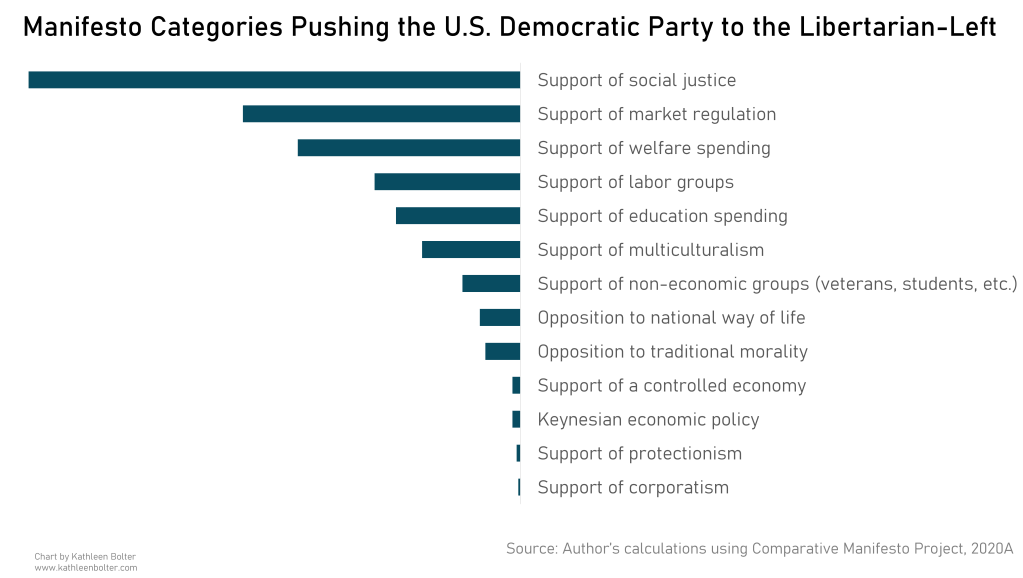
The Democratic Party is primarily in the libertarian-left category because of their endorsement of social justice and market regulation.
In examining where the American political parties fall in relation to other countries, we can see some interesting patterns.

We see that the U.S. Democratic Party finds its political party platform squarely in line with other left-libertarian parties. The progressive causes advocated by these parties include universal basic income and raising the minimum wage. Notable policies passed by left-libertarian parties include the banning of semiautomatic weapons, prohibiting discrimination based on sexual orientation, and the passage of legislation allowing same-sex marriage.
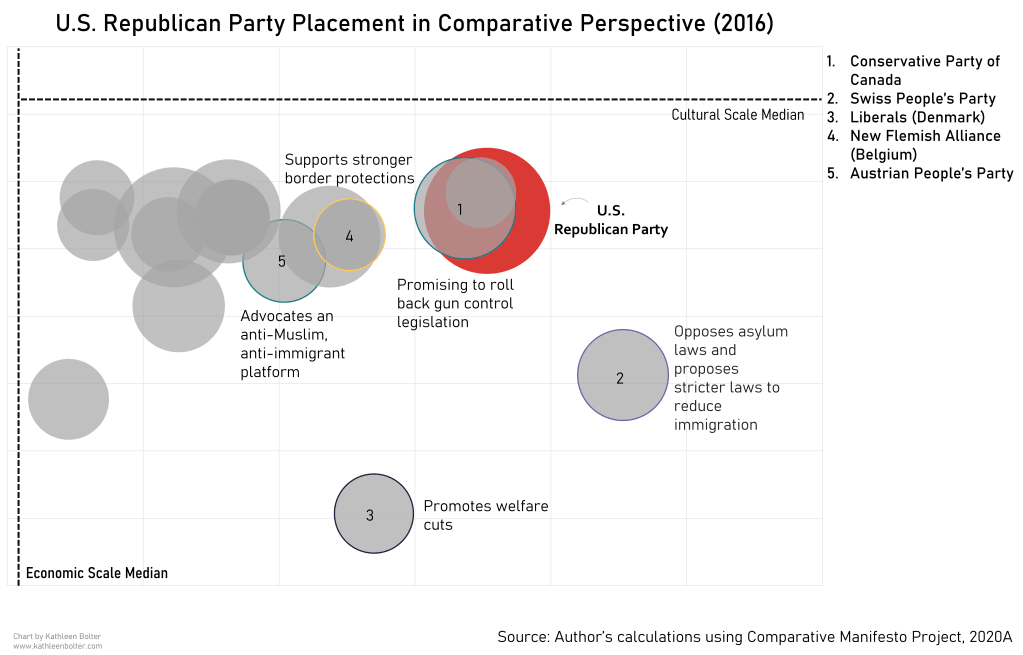
The U.S. Republican Party, on the other hand, finds its political party platform in line with other right-authoritarian parties. These include European parties that advocate for similar policies such as stronger border protections, stricter immigration laws, the roll back of gun control legislation, and cuts to welfare spending. Today, the U.S. Republican Party finds its platform as extreme as many European populist far-right parties.
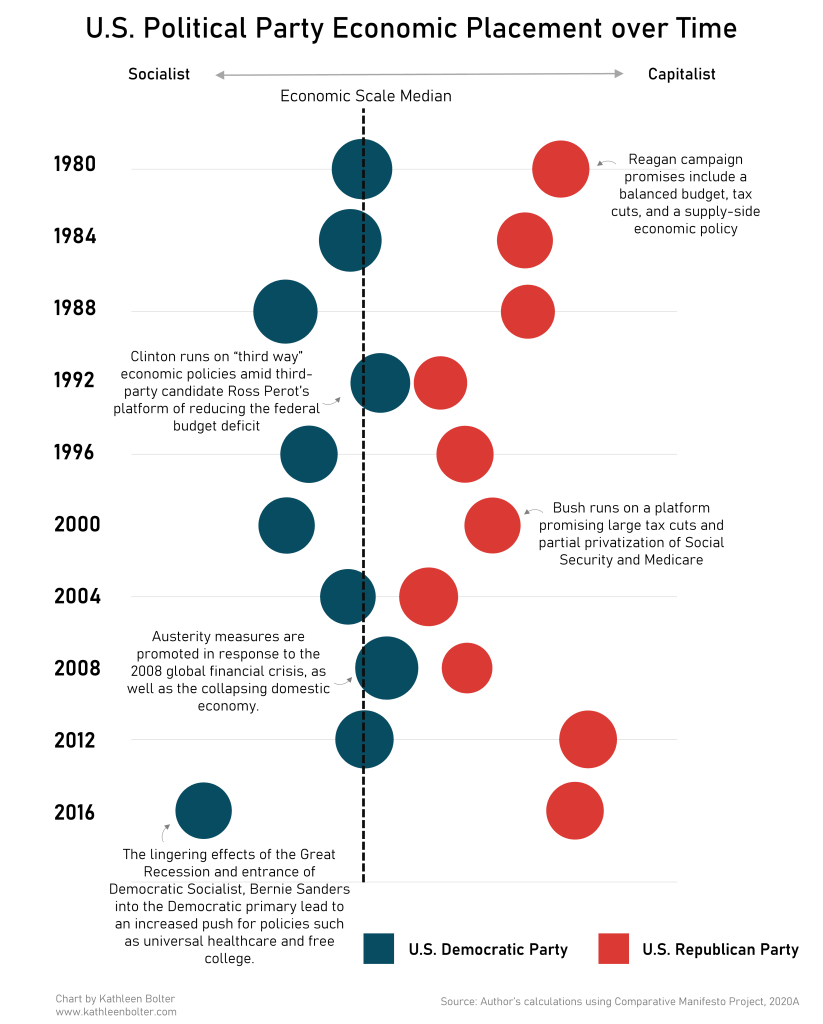
This positioning of the U.S. political parties relative to their counterparts is a relatively recent phenomenon. Looking at the economic placement of the parties, we see that both had remained close to the center, and in many cases close to each other through much of the post-war period. However, in 2016, the Democratic Party took a sharp turn to the left. Much of this turn had to do with a renewed call for market regulation, as well as an increased focus on social justice. Alternatively, the Republican Party renewed their focus on free market principles.
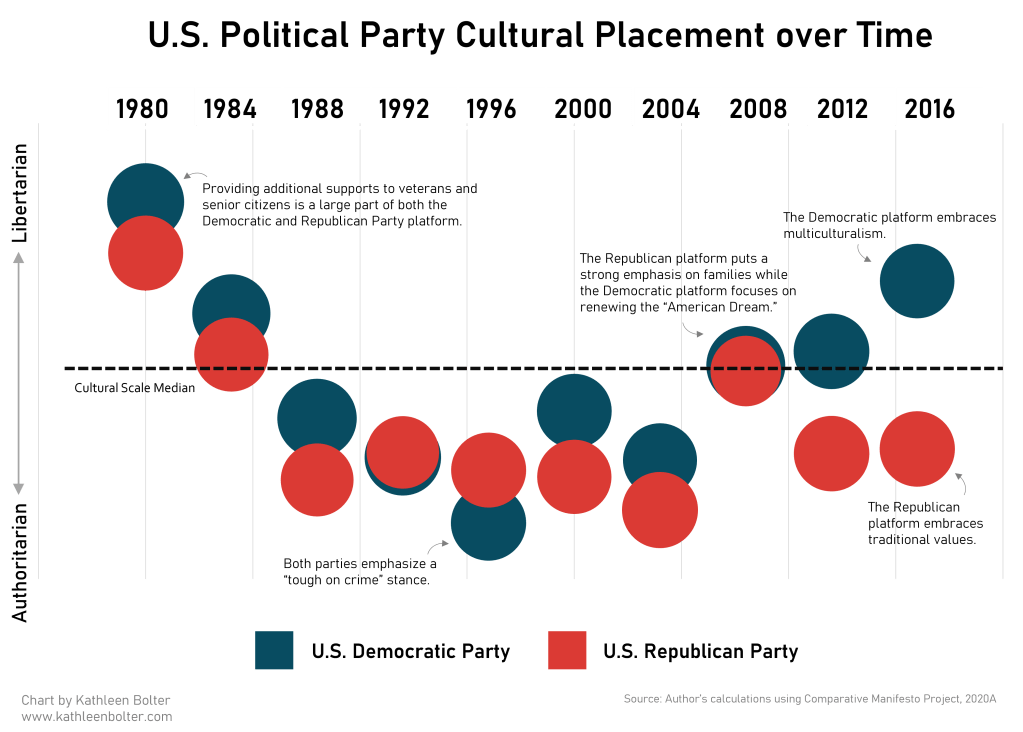
Culturally, for the past 30 years, we see a similar trend, with the Democratic Party and Republican Party closely in step. However, beginning in 2012, we see a divergence with the Democratic Party embracing multiculturalism and a willingness to criticize the status quo. The Republican Party took a different tactic doubling down on traditional moral and religious values and stanchly defending law and order.
The trends in the positioning of U.S. political parties reveal several things. First, the parties are becoming more and more dissimilar. In doing so, they are moving in completely different policy directions, the Democratic Party is embracing a platform of progressive cultural values and market regulation, while the Republican Party is embracing a platform of traditional cultural values and free market capitalism. This has potential repercussions for a governing system that requires consensus and compromise to function.
Second, the U.S. political parties are moving away from the center and towards more extreme policy positions. This is unusual, not just because of the divergence, but because of where the parties are situated in comparison to the rest of the world. Comparatively, the U.S. Democratic Party is aligned closer to left parties in other advanced industrialized countries, while the U.S. Republican Party is aligned closer to far-right parties in other advanced industrialized countries. This has major ramifications for the policy positions adopted by each party’s government and how they align with how the rest of the world governs.
For a country that once had very centrist parties, the movement of the U.S. political parties to more extreme axes within the political policy space represents an abrupt change from the status quo and a likely disruptor for the stability and strength of U.S. policies.
Sources
Kitschelt, Herbert. The transformation of European social democracy. cambridge university press, 1994.
McDonald, Michael D., and Silvia M. Mendes. “Checking the party policy estimates: Convergent validity.” (2001).
Ward, Dalston, Jeong Hyun Kim, Matthew Graham, and Margit Tavits. “How economic integration affects party issue emphases.” Comparative Political Studies 48, no. 10 (2015): 1227-1259.
 Kathleen Bolter, PhD
Leave a comment