
The COVID-19 pandemic has tremendously impacted many different aspects of life. Perhaps most startlingly has been the impact of the pandemic on gender equality. In many ways, women are already disadvantaged within the workforce, especially in the United States where there are few supports for individuals that must balance unpaid care work and paid work. Culturally, women are expected to take on more unpaid care work, such as making sure the children are receiving schooling or taking care of a sick relative. Additionally, women, in the aggregate, earn less than men making stepping back from their career the more rational choice for families needing one person to exit the labor market. During the COVID-19 recession where supports for education, childcare, and healthcare have eroded, this has resulted in many women exiting the workforce to take care of their families.
The COVID-19 recession has been especially hard on women workers. In previous recessions, men lost more jobs than women. Much of this disparity was the result of occupational mix, where sectors where men dominated, such as manufacturing and construction, were particularly hard hit by job losses. The COVID-19 recession has been different, with sectors such as health care, education, and accommodation and food services – female dominated fields – taking large hits.
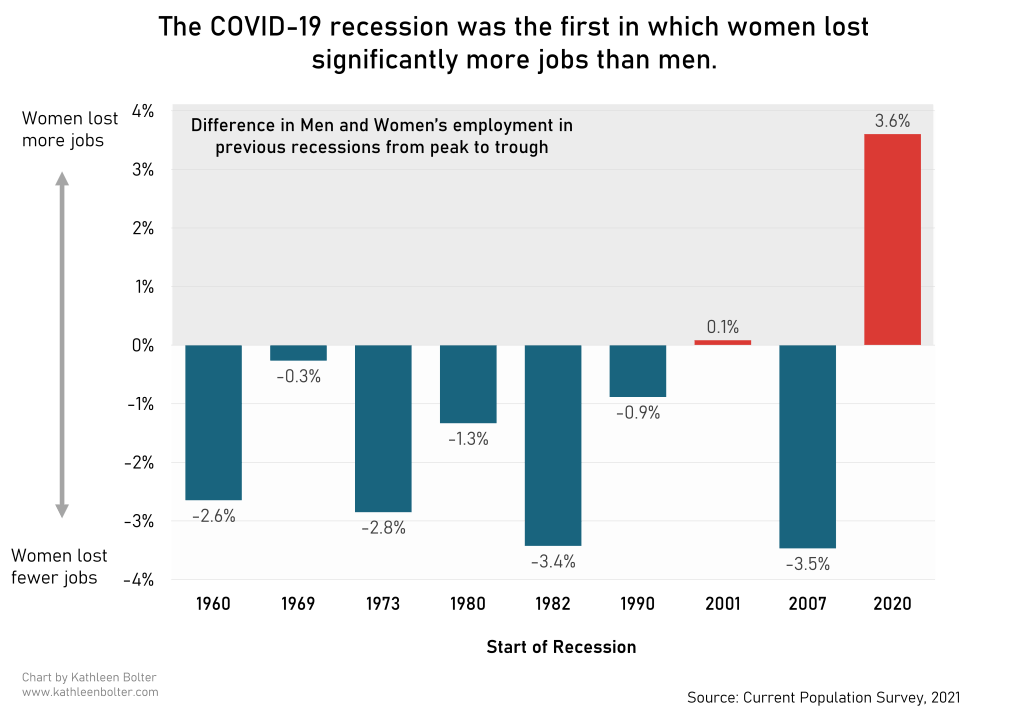
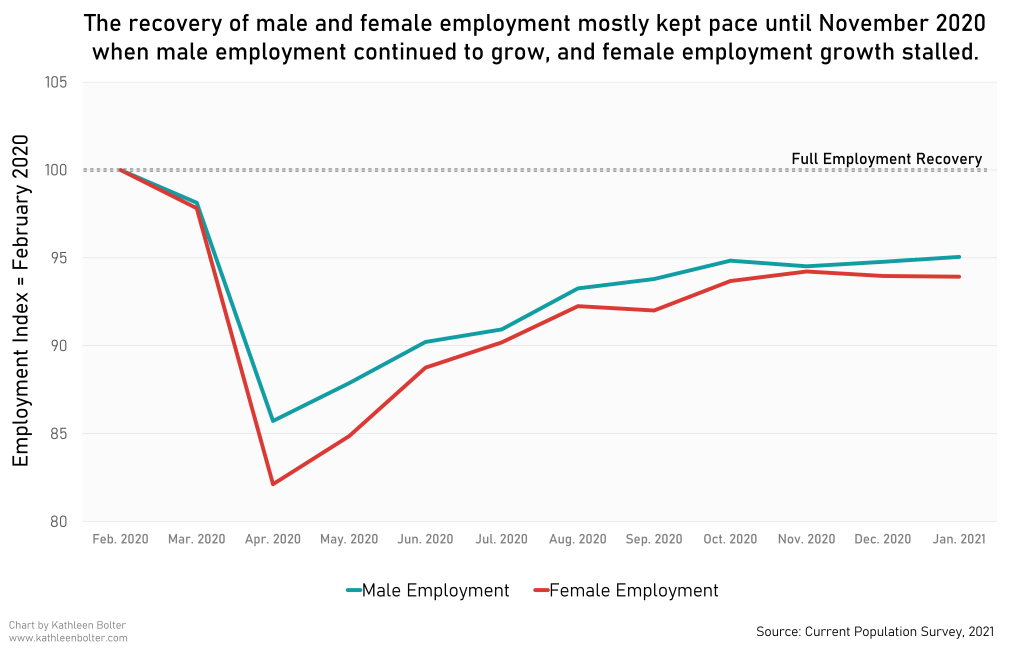
Yet, while women suffered job losses in the beginning of the pandemic, up until about November 2020, men and women’s job gains roughly kept pace with each other. In November 2020, this recovery started to diverge. In December 2020 and January 2021 men accounted for virtually all of the employment growth in the United States labor market.
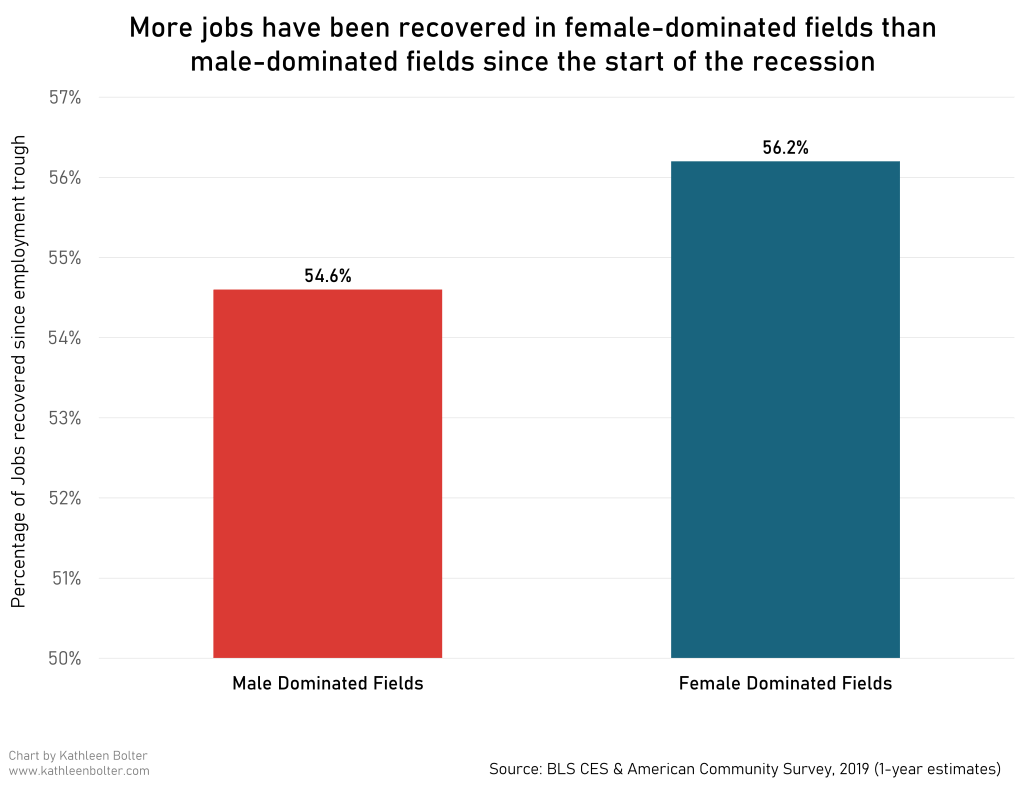
While occupational mix helps to explain job losses, it provides less of an explanation for employment recovery. While close, female dominated fields have recovered more jobs than male dominated fields. Yet, while traditionally female fields are recovering, women have had difficulty reentering the workforce.
One of the most significant barriers to returning to work for many women has been the closure of schools and daycare facilities. Over the past year, almost a million more women with children in the home have cited they are not in the labor force because they are taking care of house or family. At the same time, almost 400,000 men and women without children have left the labor force to take care of house or family indicating a significant spike in the need for unpaid care. While an additional 200,000 men with children have left the labor force for the same reason, women with children are the primary group leaving the labor force to take on this responsibility.
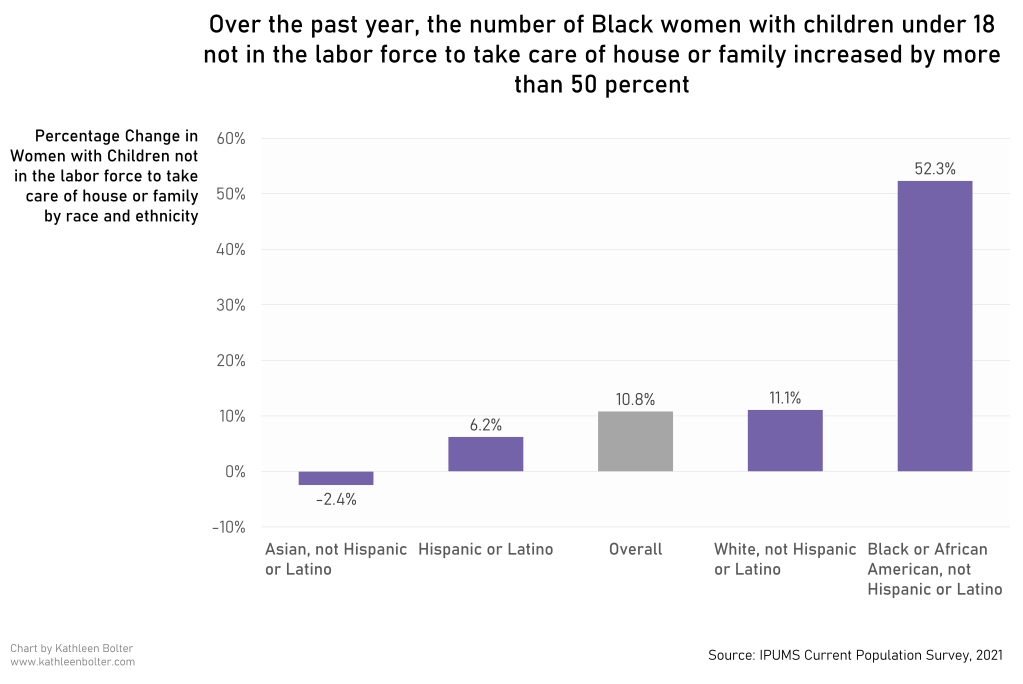
The proportion of women leaving the labor force to take care of house or family has not fallen equally among racial and ethnic lines. While the overall increase in women citing this as a reason for leaving the labor force was 10.8% from January 2020 to January 2021, the percentage of Black women citing this as a reason for leaving the workforce increased by more than 50%. White and Hispanic women also saw increases in this area, but not to the same extent as Black women.
Having to leave the labor force to take care of children has a detrimental impact on women’s careers. Women who take career breaks to raise children find themselves penalized in the workforce. By taking time off of work, women have reduced work experience upon reentering the labor market. This can result in reduced wages (Budig & England, 2001). Some studies have found career breaks have a negative impact on women’s future earnings, even if the career break is of short duration (Jacobsen & Levin, 1995; Aisenbrey, 2009).

Overall, the COVID-19 recession has decimated employment in the United States. Just over half of jobs that were lost during the lockdowns have returned. Many people have faced long and sustained levels of unemployment. Unemployment has a strong negative impact on earnings relative to those that do not face unemployment (Davis & Wachter, 2011). Workers employed for 26 weeks or longer face lower earnings than those that are unemployed for a shorter period of time (Cooper, 2013). Yet, while unemployment, especially in the face of a catastrophic global pandemic is in many ways entirely out of the worker’s hands, the need for women to leave the workforce to take on a greater share of the care burden is the result of poorly designed public policies.
The United States has some of the most regressive family policy in the world with very few supports given to families, even under the best of situations. If anything, this current crisis has only served to strengthen the stratification that exists between women and men within the workforce with a greater number of women leaving paid employment than men. It is truly heartbreaking that our policies ignore the tremendous amount of unpaid labor that people do within the family and how this work structures the lives of women and their employment opportunities. Sadly, a generation of women are likely to continue to bear the costs of the recession for simply trying to do what is best for their families.
Sources:
Aisenbrey, Silke, Marie Evertsson, and Daniela Grunow. “Is there a career penalty for mothers’ time out? A comparison of Germany, Sweden and the United States.” Social Forces 88, no. 2 (2009): 573-605.
Budig, Michelle J., and Paula England. 2001. “The Wage Penalty for Motherhood.” American Sociological Review 66(2):204-25.
Cooper, Daniel. “The effect of unemployment duration on future earnings and other outcomes.” (2013).
Davis, Steven J., and Till Von Wachter. 2011. “Recessions and the Costs of Job Loss.” Brookings Papers on Economic Activity 1–72.
Jacobsen, Joyce P., and Laurence M. Levin. 1995. “Effects of Intermittent Labor Force Attachment on Women’s Earnings.” Monthly Labor Review 118(9):14-19.
 Kathleen Bolter, PhD
Leave a comment