
Originally published here.
Key Takeaways
- Trade, globalization, and shifts in industrial organization have changed the type of goods produced in the U.S. and indirectly led to automation as advanced manufacturing becomes the standard.
- Automation has both positive and negative impacts on jobs. Automation displaces low-skill workers, while providing job opportunities for high-skill workers.
- As a result of automation, the production jobs remaining require workers to have more skills than in the past.
Following the end of WWII, the post-war economy saw a boom in the production of consumer goods. Between 1948 and 1973, total employment in manufacturing increased by 71%. At this point in time, manufacturing employed almost a third of all U.S. workers. Total employment in manufacturing would peak in 1979 with over 19 million workers. This would be followed by a gradual decline in manufacturing employment over the next 40 years.

Manufacturing jobs provided many opportunities for workers, especially those without a college degree. Jobs in manufacturing, on average, paid higher wages than other private sector jobs. They were also more likely to offer benefits to employees such as retirement plans, paid vacation, and medical care. The decline in manufacturing employment, meant a decrease in middle-class opportunities for less-educated workers.

The manufacturing sector is especially vulnerable to fluctuations in the business cycle, with recessions in the economy hastening the decline of manufacturing jobs. From 1980 to 2000, manufacturing employment remained relatively stable, with between 17 and 18 million people employed in manufacturing jobs. However, beginning in 2000, the U.S. economy began shedding manufacturing jobs at an alarming pace. Between 2000 and 2010, total jobs in the manufacturing sector decreased by 33%.

The introduction of ATM’s reduced the need to hire bank tellers to perform the same functions. As a result, technology served as a substitute for the tasks of the bank teller, leading to a decrease in employment.

Several studies have sought to answer what was behind the decline of manufacturing jobs between 1979 and 2010. None of the studies identify automation as the primary factor. Instead, trade, globalization, and shifts in industrial organization are far more influential in explaining manufacturing job loss during that time period. Low-skill workers in labor intensive industries, such as textiles, furniture, apparel, and paper manufacturing were most impacted by these economic shifts because their jobs could be done for far less money by people in lower cost labor markets.
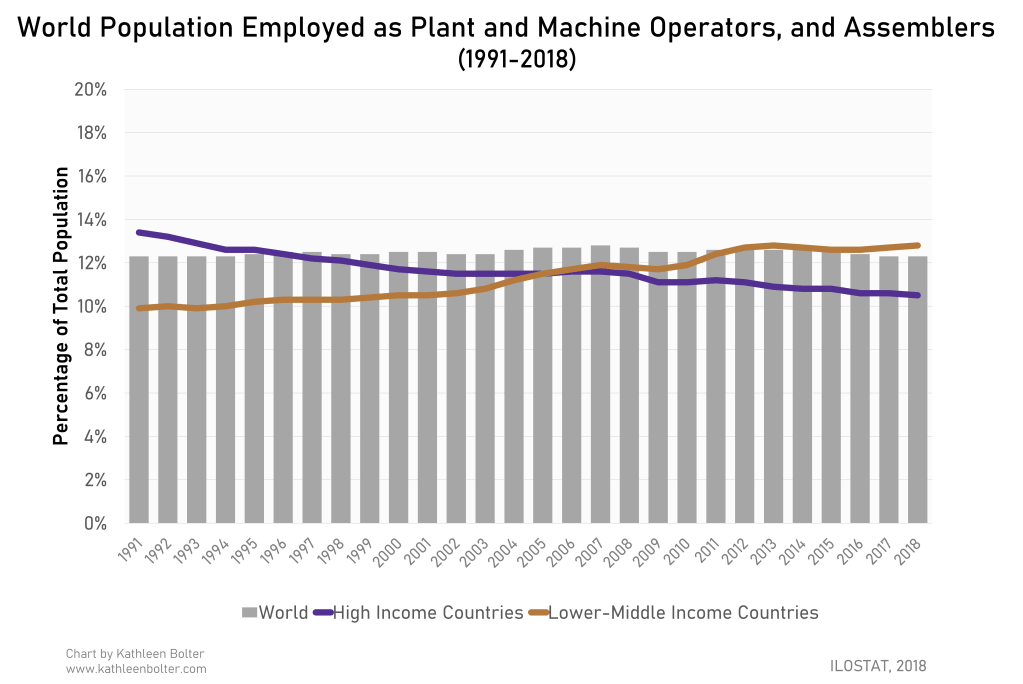
Perhaps the strongest evidence that automation has not fully replaced manufacturing jobs is the percent of the world population employed as manufacturing workers has remained relatively steady over the past 25 years. If automation were completely replacing workers, there would be worldwide decline in manufacturing employment as factories around the globe invest in technology to fully substitute for human labor. Instead declines in manufacturing employment have been primarily concentrated in wealthier countries, where labor is more expensive, while less-developed countries have seen their share of manufacturing employment grow.

The impact of trade, globalization, and shifts in industrial organization on manufacturing goes beyond job loss nationally. The movement and reorganization of labor intensive industries has fundamentally changed the manufacturing sector and how products are produced in the U.S. Advanced manufacturing integrates far more technology into it’s processes than traditional manufacturing including predictive analytics, augmented reality, additive manufacturing (3D printing), and advanced robotics. The introduction this technology into the manufacturing sector has made workers more productive as these technologies improve efficiency and reduce hazards.

Since the Great Recession, the adoption of industrial robots used in U.S. manufacturing has accelerated. In 2010, there were around 96,000 industrial robots in use in the United States, by 2015, this number had more than doubled to just under 235,000. Robots are able to substitute for many tasks in manufacturing and are able to perform those tasks more consistently and efficiently than people. The metal industry, electronics industry, and automotive industry are the chief drivers of this growth.
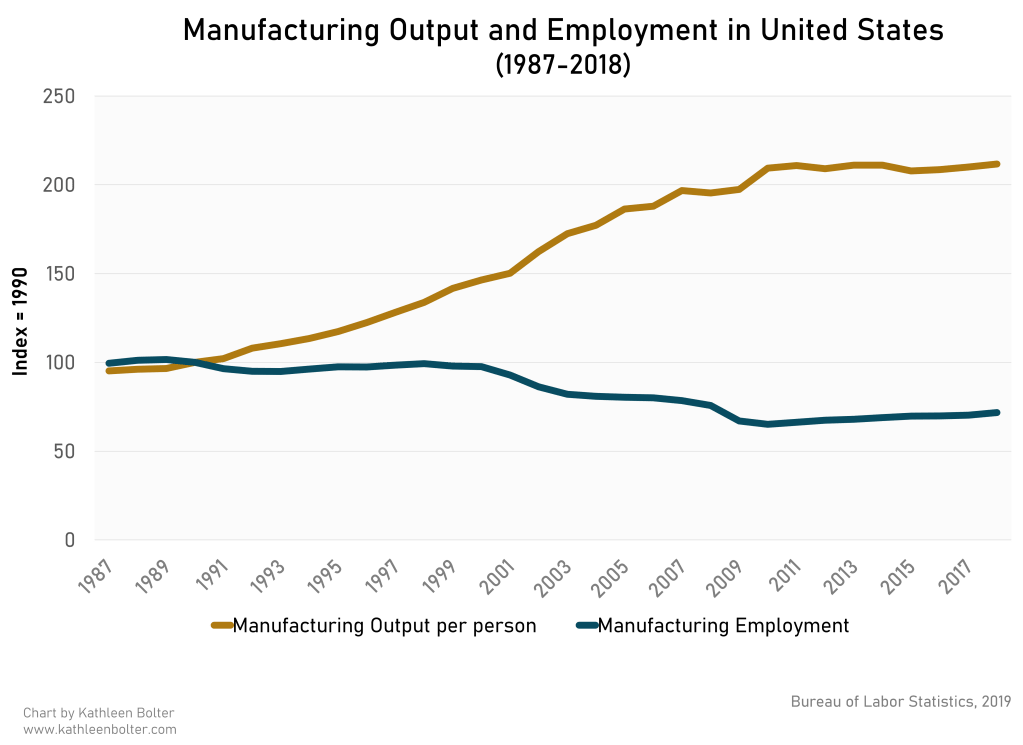
Automation has made workers more efficient. While employment in manufacturing has declined, output in manufacturing has increased. When firms produce more output with fewer workers they have increased their productivity. Since 1990, output per person, per hour in manufacturing has more than doubled. Technological innovation is one of the drivers of this increase in productivity, however other factors such as product and process improvements also influence productivity.

The impact of automation on employment is both positive and negative. Industrial robots do substitute for tasks that would normally be completed by humans therefore leading to some direct displacement of workers by robots. This displacement manifests by decreasing the demand for workers that can execute routine tasks. For example, a new factory installs industrial robots to spray paint its final product. This factory still needs to hire other workers, but rather than hire many people to spray paint the final product, instead, the industrial robot is capable of doing this. Spray painters are displaced because there is no spray paint job available and they need to find another role in the factory or elsewhere for their employment. Other workers benefit from the new factory which has created jobs for them. Workers without a college degree are particularly impacted by this displacement as the nature of jobs are rapidly restructured. Individuals with the right skills are more likely to face positive outcomes from automation, while those lacking those skills bear many of the negative consequences of this technological adoption.

As a result of automation, within manufacturing sector itself, there is a greater premium placed on workers with higher skill levels and abilities. Manufacturing jobs today require multifaceted workers with the ability to engage in problem-solving, critical-thinking, and creativity. Highly skilled production workers are becoming increasingly essential to the operation of factories and plants.
Conclusion
- Automation has displaced many low-skilled workers. Many middle-class jobs that would have been available in the past simply do not exist today.
- Automation within manufacturing has generally been positive by boosting the productivity of firms.
- Increases in productivity have led to job growth, but mostly for high-skilled workers.
Sources
Acemoglu, Daron, David Autor, David Dorn, Gordon H. Hanson, and Brendan Price. “Return of the Solow paradox? IT, productivity, and employment in US manufacturing.” American Economic Review 104, no. 5 (2014): 394-399.
Autor, David H., David Dorn, and Gordon H. Hanson. “The China syndrome: Local labor market effects of import competition in the United States.” American economic review 103, no. 6 (2013): 2121-2168.
Autor, David H., David Dorn, and Gordon H. Hanson. “The China syndrome: Local labor market effects of import competition in the United States.” American economic review 103, no. 6 (2013): 2121-2168.
Autor, David H., Frank Levy, and Richard J. Murnane. “The skill content of recent technological change: An empirical exploration.” The Quarterly journal of economics 118, no. 4 (2003): 1279-1333.
Berlingieri, Giuseppe. “Outsourcing and the Rise in Services.” (2013).
Boehm, Christoph E., Aaron Flaaen, and Nitya Pandalai-Nayar. “Multinationals, offshoring, and the decline of US manufacturing.” Journal of International Economics 127 (2020): 103391.
Campbell, Douglas L. “Relative prices and hysteresis: evidence from US manufacturing.” European Economic Review 129 (2020): 103474.
Hicks, Michael J., and Srikant Devaraj. “Manufacturing & Logistics.” (2017).
Houseman, Susan N. “Understanding the decline of US manufacturing employment.” (2018).
Rowthorn, Robert, and Ramana Ramaswamy. “Growth, trade, and deindustrialization.” IMF Staff papers 46, no. 1 (1999): 18-41.
 Kathleen Bolter, PhD
Leave a comment