
Recent data from the Bureau of Labor Statistics (BLS) suggest as of August 2020, only half of the twenty-two million jobs lost between February 2020 and April 2020 have been recovered. Particularly hard hit by the COVID-19 recession, are jobs in the leisure and hospitality industry. While this sector makes up only 13% of private sector jobs in the United States in 2019, as of August, it accounted for a total of 36.1% of all jobs displaced by the COVID-19 recession. Many of these jobs are low wage and part-time meaning that workers that are already disadvantaged in the labor market are bearing the brunt of the economic downturn. As summer turns into fall and American’s hunker down for what looks to be a long winter, the fate of jobs within these industries is less than optimistic.

Many jobs in leisure and hospitality exist within the “experience economy.” The experience economy is a bit of a nebulous term used to describe industries that create memorable events for their customers. In many ways, the memory of the event is what is being sold, rather than a particular good or service (although souvenirs and mementos do not hurt the bottom line). Activities such as sporting events, music festivals, museums, theme parks, and fine dining are all part of this experience economy. This focus on experiences instead of things has long been a rallying mantra for the millennial generation, 78% of whom would rather spend money on a satisfying experience, rather than a buying a desirable good. Millennials, of course do not hold a monopoly on these activities, consumer spending on experiences had grown across the board.

The COVID-19 recession has put a damper on the leisure and hospitality industries. First, with community spread of the virus, it is undesirable for individuals to participate in activities whose sole purpose is to bring people together. Second, many states still have policies limiting large-scale gatherings which reduces access to experiences. This dearth of events is taking a toll on these industries.

Leisure and hospitality include all industries within Arts, Entertainment, and Recreation (NAICS 71) and Food and Accommodation (NAICS 72). Leisure and hospitality industries saw a large drop at the beginning of the COVID-19 recession and have failed to recover. The leisure and hospitality industries had 24.7% fewer jobs in August 2020 compared to February 2020. All other industries had only 5.7% fewer jobs in August 2020 compared to February 2020.

The recovery of the leisure and hospitality industries has itself been uneven. Almost half of all jobs in performing arts companies, amusement parks and arcades, and for promoters of performing arts, sports, and similar activities have yet to rebound. It is additionally, important to reinforce that as these industries remain below capacity, many other jobs supportive to these industries are not captured in this data such as food service contractors, security contractors, and custodial contractors which, with few events to work for, face additional employment insecurity.

Nationally, leisure and hospitality jobs make up 13% of private sector employment. However, the distribution of such jobs is not even across the country. While not a perfect predictor of unemployment levels, many metropolitan areas with high levels of employment in leisure and hospitality industries are facing high levels of unemployment. As the summer season winds down, many of the seasonal jobs in leisure and hospitality will wrap-up. Open Table, which aggregates restaurant reservations shows that reservations were down about 50% in the month of August from where they were a year ago. While conditions have certainly improved since the spring, as we head into the fall, the continued recovery of the leisure and hospitality industries appears tenuous at best.
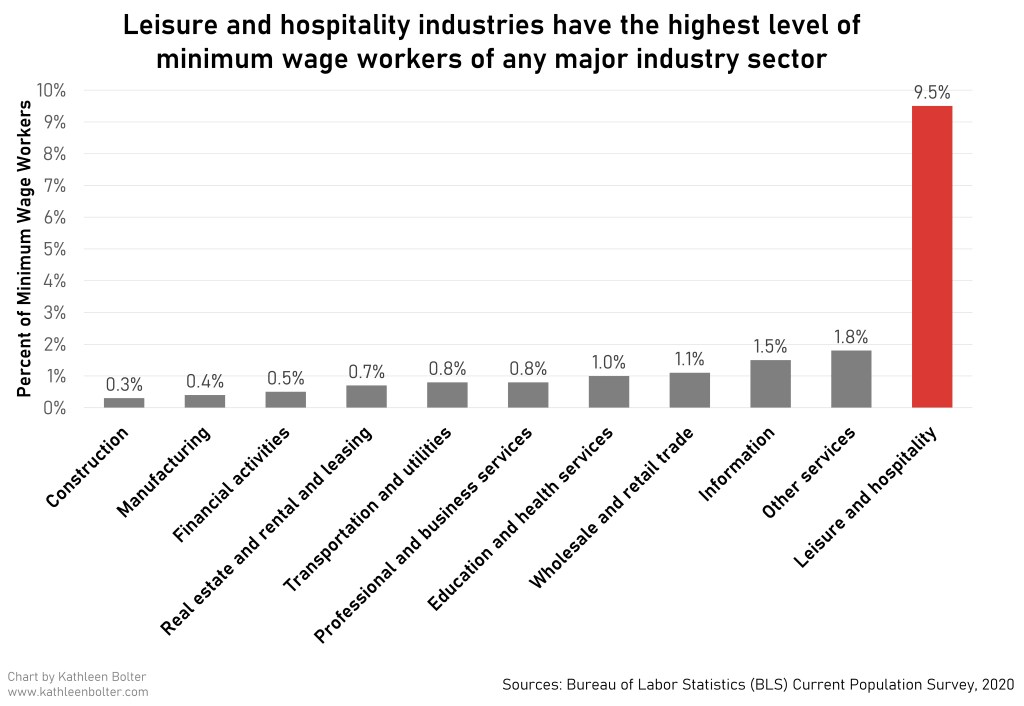
The loss of leisure and hospitality jobs is important because of the outsize impact such job losses have on low wage workers. In 2019, just under 10% of workers in the Leisure and Hospitality Industry earned at or below the federal minimum wage, the most of any major industry sector. The average weekly wage for Leisure and Hospitality workers was $482 in 2019, less than half of the average weekly wage of $1,138 for all industries. Essentially, the loss of leisure and hospitality jobs has disproportionately impacted workers who earned very little to begin with and already faced unstable and precarious working conditions. It is questionable whether, low wage workers will be able to withstand a long-term downturn in their industry without additional aid.
Sadly, the trends contributing to below average employment in leisure and hospitality are unlikely to turn around at any point soon. The primary selling point of such activities are experiences and unfortunately, what makes these activities so enjoyable in the first place is starkly in opposition to the guidelines for preventing the spread of COVID-19. It is unlikely that these industries will return to normal until the end of the pandemic.
 Kathleen Bolter, PhD