
Starting in the 1980s, job growth stopped being evenly distributed across different types of jobs. Instead, it became more uneven, with most of the new jobs being in either high-paying or low-paying fields. This is known as “labor market polarization,” and it means that there are fewer jobs in the middle-paying category.
To explain labor market polarization and its consequences, let’s explore with this cartoon.
Let’s start with 10 people each representing 10% of the workforce in 1980.

Looking at how much people earn in different jobs, around 30% are low-wage workers, about 40% are middle-wage workers, and the remaining 30% are high-wage workers.

Automation, the replacement of human tasks with technology, primarily impacts middle-wage jobs. This is because these middle-wage jobs are comprised of routine tasks. Routine tasks are repetitive, predictable, and can be accomplished by following explicit, well-understood rules making them easily substituted for by technology.
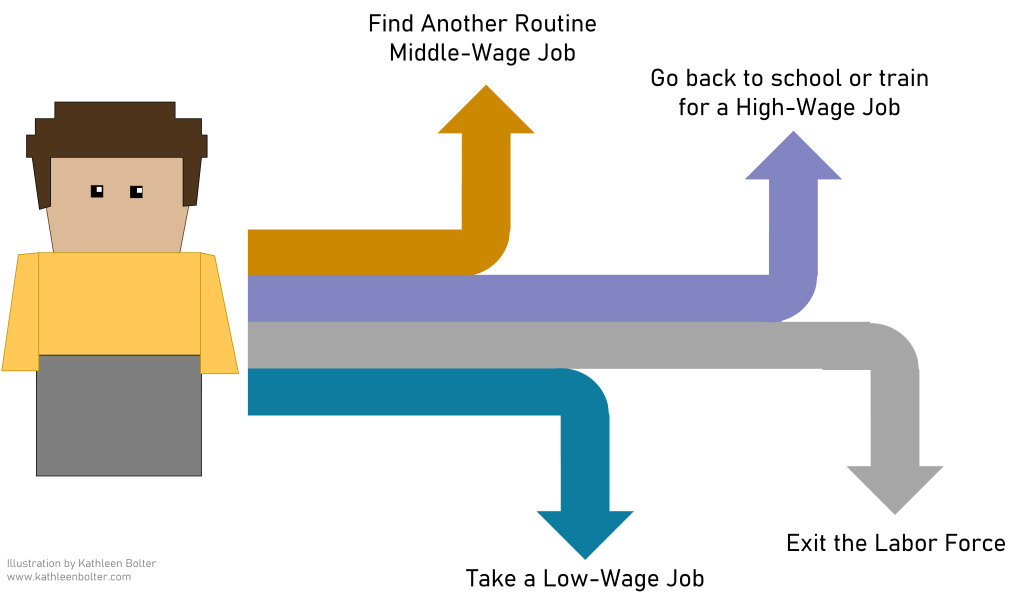
Workers displaced by automation faced several options in the job market. First, they could try to find another routine middle-wage job. However, as these jobs decreased in quantity, it became more difficult to find similar jobs. The worker could go back to school or train for a high-wage job. This was generally a more attractive option for younger workers than older workers who were less likely to recoup the costs of additional training with increased earnings. The worker could take a low-wage job. Again, this was not an attractive option as low-wage jobs do not pay very well. Finally, workers had the option of exiting the labor market entirely. This was the option adopted by many middle-wage workers who found themselves unemployed.

The adoption of technology also increased the education and training required for middle-wage jobs, especially those that require cognitive skills. Recessions have been shown to significantly increase the training and experience requirements for those in clerical and sales jobs. As a result, entry into these professions require more education than they did in the past.

Much of the erosion of middle-wage jobs has been a result of shifts within different industrial sectors of the economy leading to greater demand for those with higher levels of skills and training. Also known as “skill-biased technological change,” demand increased in favor or more educated workers. While high wage workers made up 27% of the labor force in 1980, by 2019, 40% of the workforce worked in high-wage jobs.

High-wage workers have made a lot more money because of this higher demand, with their wages going up even more. When you account for inflation over the last 40 years, middle-wage workers’ pay has stayed pretty much the same. Those in professional, managerial, and technical jobs have seen their wages go up by more than 33% in the past 40 years. This kind of wage growth, mostly happening for people at the top end of the income scale, is a big reason for income inequality in the U.S.

Overall, advancements in technology have led to job polarization. While increased levels of schooling have resulted in changes in the supply of relatively more educated workers. This has combined to create an increase in the demand for more-educated workers as a result of technological change. The labor market of today is very different from the labor market of 40 years ago as automation has increased the demand for high-wage workers and exacerbated income inequality.
Sources:
Acemoglu, Daron, and David Autor. “Skills, tasks and technologies: Implications for employment and earnings.” In Handbook of labor economics, vol. 4, pp. 1043-1171. Elsevier, 2011.
Autor, David H., Lawrence F. Katz, and Melissa S. Kearney. “The polarization of the US labor market.” American economic review 96, no. 2 (2006): 189-194.
Hershbein, Brad, and Lisa B. Kahn. “Do recessions accelerate routine-biased technological change? Evidence from vacancy postings.” American Economic Review 108, no. 7 (2018): 1737-1772.
 Kathleen Bolter, PhD