
Political Economists are sometimes bad at naming things.
Decommodification, the degree to which a person can maintain a livelihood without reliance on the market, is an example of one of those important terms that hardly rolls off the tongue. As the world faces an unprecedented crisis as the result of the Covid-19 pandemic, understanding the underlying theory of this concept is important as it has real-world implications for people’s quality of life.
As the pandemic lies bare the amount of inequality in American society, there is a louder and louder call for the government to step in to guarantee services, such as healthcare, income, and higher education as a matter of right. In this cartoon, let’s explore how different countries have implemented such regimes and how that has impacted unemployment in each regime type.
In classical political economy literature, there are three primary types of welfare states: Liberal, conservative-corporatist, and social democratic. The welfare state refers to the different systems adopted by governments to protect the well-being of their citizens. The generosity of welfare state benefits differs between each of the regimes and produces significantly different levels of decommodification.
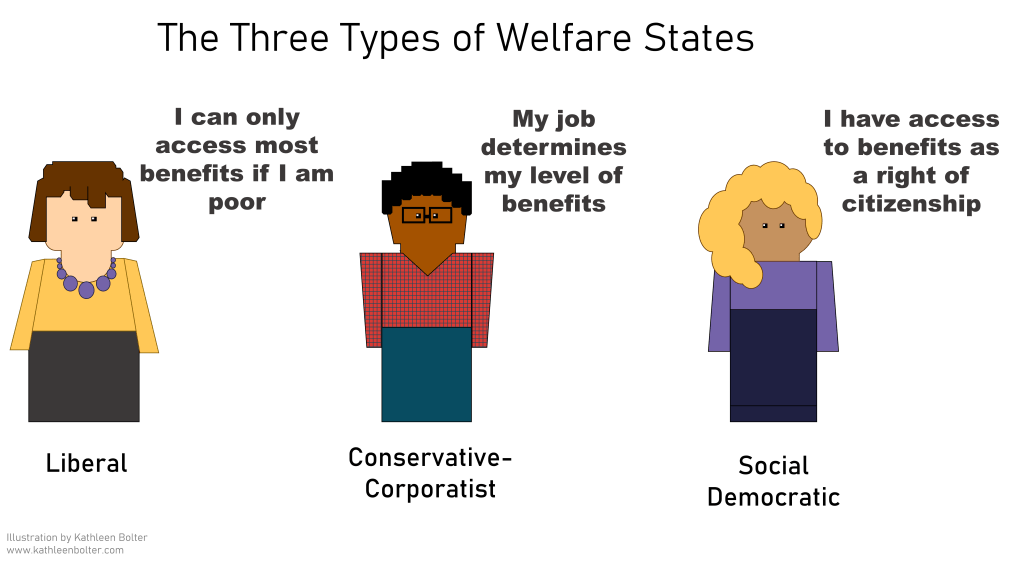
Liberal Welfare States
- Low levels of decommodification
- The market determines access to social insurance which are means-tested and restricted
- Welfare system relies heavily on charity and voluntary insurance schemes
- Typical countries in this regime: Australia, Ireland, United Kingdom, & United States
Conservative-Corporatist Welfare States
- Medium levels of decommodification
- The workplace determines social insurance benefits which are related to occupational status and based on individual contributions
- The state will only interfere when a family’s capacity to help it’s members is exhausted
- Typical countries in this regime: Austria, Belgium, France, Germany, Switzerland
Social Democratic Welfare States
- High levels of decommodification.
- Citizenship determines access to generous, universal, and highly distributive social insurance benefits
- Socializes the cost of caring for children, the aged, and the helpless instead of waiting for the family’s capacity to support them is depleted.
- Typical countries in this regime: Denmark, Norway, & Sweden
Let’s take the example of losing your job in each regime, what would happen?
Losing your job in the United States
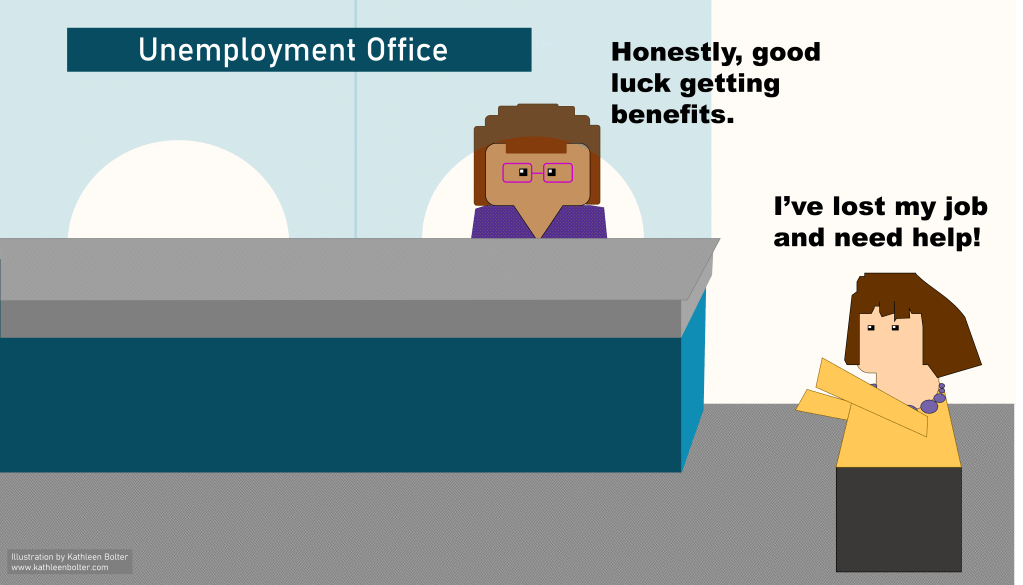
The United States has no centralized unemployment system, instead each U.S. state administers its own unemployment insurance program. Benefits are generally funded by state and federal payroll taxes paid by employers (although employees in some states are expected to contribute to the system). In most states, unemployment insurance is paid for up to 26 weeks (although in some states this is far less) and during severe economic downturns, this benefit duration has been extended. The total benefits paid to workers is generally set at 50% of the unemployment recipients previous wage, up to a maximum amount set by each state. However, job seekers must apply to their state’s unemployment office where they can be denied such benefits for a variety of reasons. Between 35% and 70% of initial claims are denied by State Unemployment Offices, depending on the state. There is no guarantee a job seeker will receive unemployment benefits or job skills training in the United States.
Losing your job in Germany

Unemployment insurance in Germany is compulsory. Workers and employers generally split payment of 2.5% of the worker’s earned income into an unemployment insurance fund. Individuals receiving unemployment insurance in Germany receive 60% of their average net wage over the past 12 months if they are childless and 67% of their average net wage from the past 12 months if they have children. Benefits are paid for up to 12 months (longer for older workers). To receive benefits, a worker must have been insured at least 12 months over the last 30 month period. The German system also provides for a basic jobseeker’s allowance which provides a monthly cash benefit to ensure that job seekers do not become destitute. Workers must register with a job center and be prepared to engage in vocational training and further educational training. Rejecting an offer of employment a place in a training course can result in the reduction or suspension of the payment. The basic job seeker’s allowance is available for 12 months, but may be re-assessed based on the job seeker’s circumstances.
Losing your job in Sweden

Individuals who lose their job in Sweden can qualify for both basic insurance and a voluntary income-related insurance benefit. The basic insurance is 365 SKE ($41.00 USD) a day, although it can be reduced if you work less than full time. It is available to anyone over the age of 20, who is enrolled with the Swedish Public Employment Service and currently pursuing a job. The income-related insurance benefit is voluntary. After one-year of uninterrupted membership in an unemployment fund performing gainful work for a minimum of 80 hours per month for 6 months, a worker is entitled to 80% of their average income over the last 12 months for 200 days. After day 201, the worker receives 70% of their previous wages, up to 300 days. Workers with children under 18 are entitled to an additional 150 days. Those still unemployed after reaching the maximum payout are eligible for other types of benefits from the Swedish Social Insurance Agency if they are receiving job skills training.
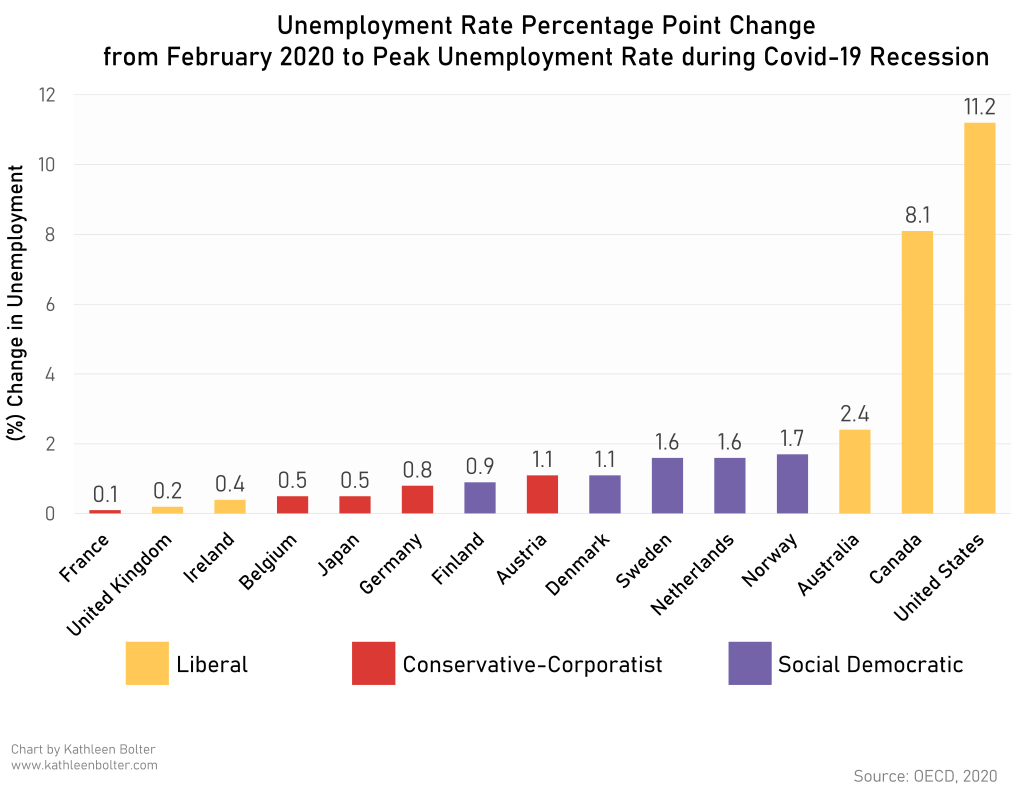
Three different countries, three entirely different experiences for people. As shown in the above chart, the level of decommodification guaranteed by governmental policies heavily impacts how something as disruptive as a job loss is likely to occur in the first place. The majority of the liberal welfare states saw large jumps in unemployment, while the social democratic and conservative-corporatist states saw only minor increases in their unemployment rates. It is worth noting that as the crisis continues, the unemployment rate continues to slowly increase in many conservative-corporatist and social democratic states. While liberal states faced a high initial shock in terms of unemployment, rates in liberal countries have quickly rebounded, although they remain higher than pre-pandemic.

It is important to note that the policy choices of welfare states are constrained by the service sector economies of advanced industrialized countries. While in an ideal world, governments would be able to pursue employment growth, fiscal discipline, and earnings equality, in reality, the tradeoffs that must be made between the three make that an impossible goal. And so liberal states are guided heavily by what is best for the market, with a dogma of minimal governmental intervention (even to prevent a crisis such as mass employment) do little to halt the blow of an economic crisis, creating highly unequal outcomes among groups within society. Conservative-corporatist states seeing harsh market generated inequalities as a danger to the social order, are more willing to intervene to blunt the outcomes of economic recessions, but do so while sacrificing employment growth. And finally, social democratic states do much to intervene to smooth out the unequal impacts of the market, but doing so comes at a monetary cost and with a need for expanded governmental budgets. The tradeoffs produced by the policy choices of each state come with a variety of benefits and costs, each contributing to starkly different outcomes for the citizens of each state.
Overall, higher levels of decommodification mean greater access to publicly available benefits and supports. Even without a job, citizens of generous welfare states face a relatively stable quality of life, while those in less generous states face higher levels of insecurity. This level of insecurity faced in liberal welfare regimes is increasingly becoming a source of tension among different social groups, especially as the Covid-19 recession has laid bare the astounding level of inequality within such societies. Other welfare regimes provide a clue as to how systems could be reformed and highlight other pathways for dampening the blow of economic crisis.
 Kathleen Bolter, PhD
Leave a comment